About us

The Annals of the University of Craiova, the Psychology-Pedagogy series, is an international academic publication with interdisciplinary characteristics that aims to promote education and educational research, to provide an expression opportunity to all the experienced specialists in the field, but also to the young researchers, facilitating the exchange of ideas and interactions at the level of the scientific community.


Call for papers

We would like to invite you to submit your articles for publication in issue 48(1) of 2026, in the Annals of the University of Craiova, Psychology-Pedagogy Series (ISSN 2668-6678, ISSN-L 1582-313X), published by the Teacher Training Department, University of Craiova, through the Centre for Psychopedagogical Research (romanian acronym CCPP).

Call for papers

Appel a la contributions


About AUCPP

The first issue of the magazine was published in 2001.

The journal accepts the following categories of studies:

  • Theoretical papers
  • Basic research papers
  • Applied research papers
  • Essays
  • Book reviews
  • Interviews

The works can approach different themes in the educational field: the initial and in-service teacher training; the development and innovation of the curriculum; the theory and practice of training; the theory and practice of the assessment; management and educational leadership; the management of the educational programs; the sociology of education; the psychology of education; university pedagogy; adult pedagogy; the history of pedagogy  and alternative pedagogies; comparative pedagogy; pedagogy of primary and pre-primary education; early education; the education of children with special educational needs; inclusive education; educational counselling; the psycho-pedagogy of learning; special didactics, etc.

Aim and scope

Analele Universității din Craiova, seria Psihologie-Pedagogie aims to publish original research articles and review articles in the field of education sciences and psychology, in some important areas: pre-service and in-service teacher training; theory and practice of training; theory and practice of the assessment; management and educational leadership; management of the educational programs; sociology of education; psychology of education; university pedagogy; adult pedagogy; history of pedagogy and alternative pedagogies; comparative pedagogy; education of children with special educational needs; inclusive education; educational counselling; special didactics etc.

The first issue of the Journal was published in 1998, under the title Analele Universităţii din Craiova. Filosofie-sociologie-psihologie-pedagogie. In 2001, the title was changed in Analele Universității din Craiova, seria Psihologie-Pedagogie. Journal is published constantly starting this year.

The International Scientific Committee of the journal is formed by members not only from Romania, but also from other countries (France, Irland, Greece, Canada, Belgium, Albania, Serbia, Republic of Moldova). The members are prestigious researchers in the field of education sciences, from important universities and scientific research institutes.

Ussualy, each issue of the journal has a different topic, wich is a real and interesting theme.

Analele Universității din Craiova, seria Psihologie-Pedagogie is published by Universitaria Publishing House.

The journal does not have article processing and submission charges (APCs).

Contact

Teacher Training Department, University of Craiova, 13, Al. I. Cuza Street, Craiova, Dolj, Postal code 200585, Romania, Telephone (040)251422567

Email: [email protected]


Current issue:

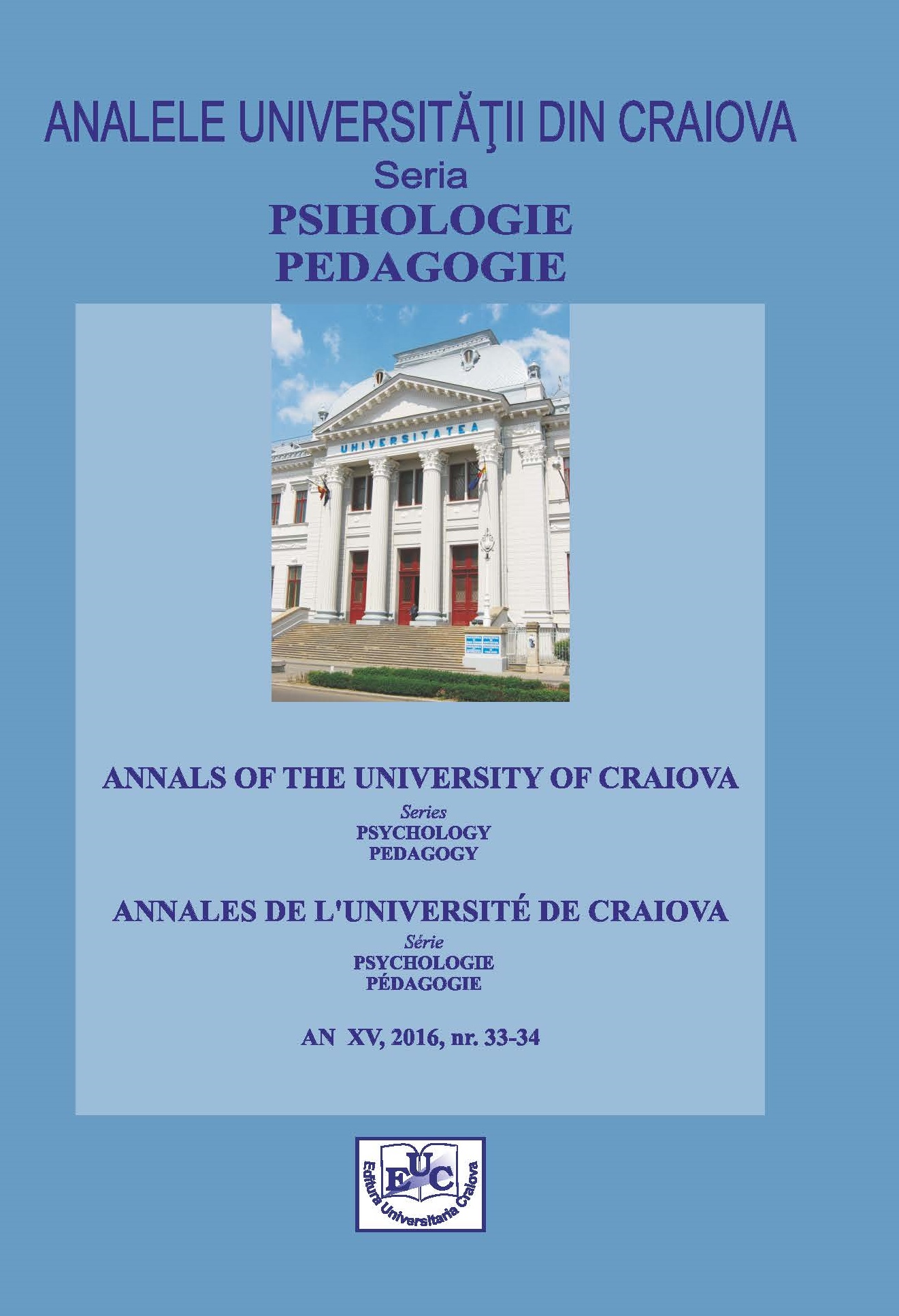
Analele Universității din Craiova, seria Psihologie-Pedagogie

Annals of the University of Craiova, Series Psychology- Pedagogy

Volume 48, issue 1/2026

Publication date: June 30th 2026

NoAuthor(s)TitlePages
1Victor Ayodeji FEHINTOLA, Habeeb Omoponle ADEWUYI, Tobi Moses OGUNNIYIPrevalence and predictors of demeaning behaviors among junior-ranking police officers in Oyo Area Command, Nigeria  9-21
2Mohammed DRIDIApproche écoculturelle du FLE : lire l’environnement saharien en contexte académique à travers Au pays des sables22-36
3Jean Désiré BANGA AMVÉNÉÉveil précoce à l’anglais et compétence de communication des etudiants francophones37-47
4Svetlana TOLSTAIA, Oxana REVENCOPsychological profile of adolescents with different levels of conflictological culture development48-60
5Naoual AOUALILes TICE comme outils de médiation linguistique et culturelle : étude de cas en classe de FLE au cycle moyen algérien61-75
6Riadh GHESSIL, Sarah SLIMANIL’évaluation des compétences rédactionnelles à l’épreuve de l’IA générative76-89
7Hatim BOUMHAOUADStudents’ uses of Generative Artificial Intelligence in higher education: perceptions, benefits, and challenges90-104
8Mohammed Larbi SI MERABET, Djilali BELAIDOUNIInvestigating the Algerian secondary education teachers’ role as researchers: Ain Merane District/Chlef as a case study105-118
9Jing GUOMotivation des apprenants en chinois à l’université : enquête comparative auprès des étudiants en l0 et l1 à l’Inalco en France119-132
10Florentina MOGONEAGood practices in academic writing133-147  
11Médéhouègnon Bernardin DOSSAL’autonomie de l’étudiant à l’ère du numérique : stratégies de régulation de l’attention en cours magistral à l’Université d’Abomey-Calavi (UAC)148-161
12Assia LAIDOUDIEfficacité du stage pratique dans la formation des enseignants algériens de FLE : retours des enseignants tuteurs de L’ENS Messaoud Zeghar (SÉTIF)162-172
13Kahina MEKHZEMAdolescent suicidal behavior: between academic stress and psychological vulnerability173-187
14Adolf MOTE, Virginie Salomée ATANGANA, Aimé MBOYANA NDONGOProfessionnel de l’éducation spécialisée face aux capacités d’adaptabilité de l’enfant avec autisme. Une analyse des processus cliniques mises en œuvre au Centre national de réhabilitation des personnes handicapées (Cameroun)188-201
15Fatiha DOUIB, Asma NESBAThe impact of leveraging English proficiency in enhancing the tourism sector in El Oued202-215
16Rasheed Ayodele KESHINROPath analytics of teachers’ psycho-demographic variables and classroom incivility among secondary school students in Ogun State, Nigeria216-226
17Alina MARDARI, Diana ANTOCIThe development pathway of communicative competence through contextual instruction in English227-241
18Sarah ABDELHAKIM, Nadia ZERROUKI, Yazid MEFTAHCommunication strategies employed by Algerian first-year middle school EFL learners during oral interviews242-256
19Judicaël ALLADATINPour une analyse des trajectoires de carrière des directions d’établissement d’enseignement : vers une instrumentation biographique quantitative257-271
20Samah BENZERROUGIntegrating artificial intelligence into EFL listening and speaking instruction: the case of ENSB Primary school teacher trainees272-285
21Kenza GHEGAGLIA, Ammar SAOUDTowards an ethical and global citizenship competency framework for AI-enhanced Higher Education Emi: a re-conceptualization of the TPACK Model286-300
22Souhila BENZERROUGPlace du discours théâtral dans la formation de formateurs : réalité et propositions didactiques301-311
23Sarah BOUCHENAK, Fathi DJEROUANEFrom policy to practice: evaluating the 2022 English curriculum reform in Algerian primary schools: parents’ perspectives from Relizane312-326
24Mankponse Augustin GNANGUENON, Judicaël ALLADATINDe la littératie statistique à la littératie des données en administration scolaire : conceptualiser une compétence professionnelle des directions d’établissement au Québec327-339
25Florentin Remus MOGONEAStrategies to consolidate the school – family – community educational partnership, in the context of contemporary societal challenges340-354
26Ecaterina Sarah FRĂSINEANUKnowledge and didactic approach of gifted people355-365
27Asma DJAIDJA, Lakhdar DOURARITwo foreign languages in Algerian primary education: cognitive overload and psycholinguistic confusion366-379
28Vali ILIEThe educational role of podcasts in the training of future teachers380-394
29Mihaela Aurelia ȘTEFANThe role of reflective journaling in mitigating perceived stress among students395-406